What Size Is a Giant Check? A Complete Dimensions Guide
The industry-standard measurements for big presentation checks, how they scale, and the resolution you actually need for a crisp print.
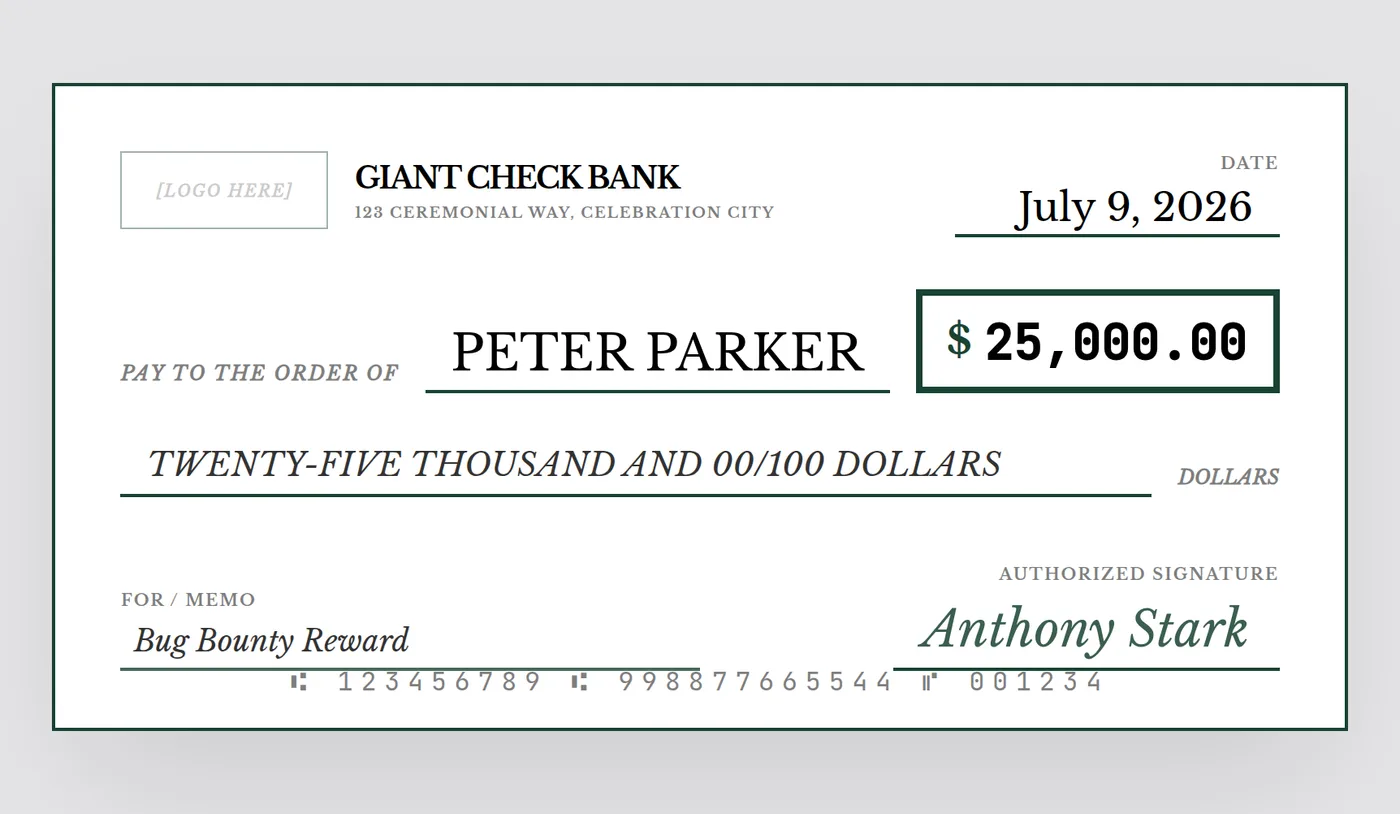
"How big should a giant check be?" is one of the first questions anyone planning a presentation ceremony runs into — and the answer has settled into a de facto industry standard, with a couple of common variants depending on the venue.
The standard size: 36" x 18"
Almost every giant check you've seen on TV, at a golf tournament, or at a charity gala is 36 inches wide by 18 inches tall — a clean 2:1 landscape ratio. It's the size that:
- Two people can comfortably hold at chest height for a photo
- Reads clearly from 15–20 feet away, including from the back of a banquet hall
- Fits a standard 36" x 24" sheet of foam board with trim room to spare
- Ships flat via most courier services without oversize freight fees
| Format | Dimensions | Typical use |
|---|---|---|
| Standard | 36" x 18" | Most fundraisers, sports awards, retail/franchise ceremonies |
| Jumbo | 48" x 24" | Stadium reveals, large stages, lottery/jackpot announcements |
| Extra jumbo | 72" x 36" (6 ft) | Televised events, arena-scale presentations |
| Tabletop / mini | 24" x 12" | Indoor photo ops, desk displays, smaller ceremonies |
| Digital / social only | 1600 x 900 px (16:9) | Reveal videos, Instagram/TikTok posts, no printing |
Why 2:1 became the standard
A 2:1 ratio mirrors the proportions of a real bank check scaled up, which is exactly why it reads as instantly recognizable — audiences know what they're looking at within a fraction of a second, which matters when the check is only on screen or on stage for a few seconds. Going much squarer (closer to 1:1) makes it read more like a certificate or plaque than a "big check."
How big can you go?
The ceiling isn't really the paper size — foam board and coroplast are available up to 4' x 8' sheets — it's the resolution of your source file. A check exported at a low pixel count will look sharp on a laptop and turn to mush the moment a print shop blows it up to 6 feet wide.
Rule of thumb for print resolution:
- 150 DPI is the minimum for a check that will be viewed from a few feet away (most presentation checks)
- 300 DPI is worth it if the check will also be photographed up close for print media
- At 36" x 18", 150 DPI works out to roughly 5400 x 2700 pixels — which is why exporting at 4x pixel density from a 1200x600 canvas (the standard on-screen giant check ratio) lands right in that zone
Bleed matters more than most people realize
Print shops trim to size after printing, and any element flush against the edge of your file risks being sliced off-center or leaving a thin white sliver if it's not accounted for. A standard 0.125" bleed margin — extending the background slightly past the trim line — is what separates a check that looks intentional from one that looks like a home-printer job.
Sizing for video and social media
If the check is a prop for a YouTube reveal or TikTok clip rather than a physical printed object, dimensions work differently — you're optimizing for pixels on a screen, not inches on foam board. See our guide to giant checks for video for exact export settings.
Every export comes pre-sized correctly
GiantCheck.me renders at the standard 36" x 18" ratio with a built-in 0.125" bleed toggle and 4x-resolution export — no guessing at DPI math.
Open the Free Designer →$10 for the clean, print-ready download · no signup required
Frequently asked questions
What is the standard size of a giant check?
36 inches wide by 18 inches tall, a 2:1 landscape ratio. This is the size used at most fundraisers, sports presentations, and corporate ceremonies.
How big can a giant check be printed?
As big as the source file's resolution allows. A file exported at 4x pixel density from a vector-quality canvas can be printed up to roughly 6 feet wide before edges start to soften; most print shops recommend staying at or under 48 inches wide for crisp results on standard equipment.
What resolution do I need for a 36x18 inch check?
For clean print output at 36 x 18 inches, aim for at least 150 DPI at full size — roughly 5400 x 2700 pixels. A 4x pixel-ratio export from a 1200x600 on-screen canvas comfortably hits that target.
Is there a smaller giant check size for indoor use?
Yes — a 24 x 12 inch "tabletop" size is common for smaller indoor presentations, photo booths, or when the check will be displayed rather than held on stage.